Methodology
The math behind being human kind. Spec v1.2.1 · May 2026
How HI Grade scores work
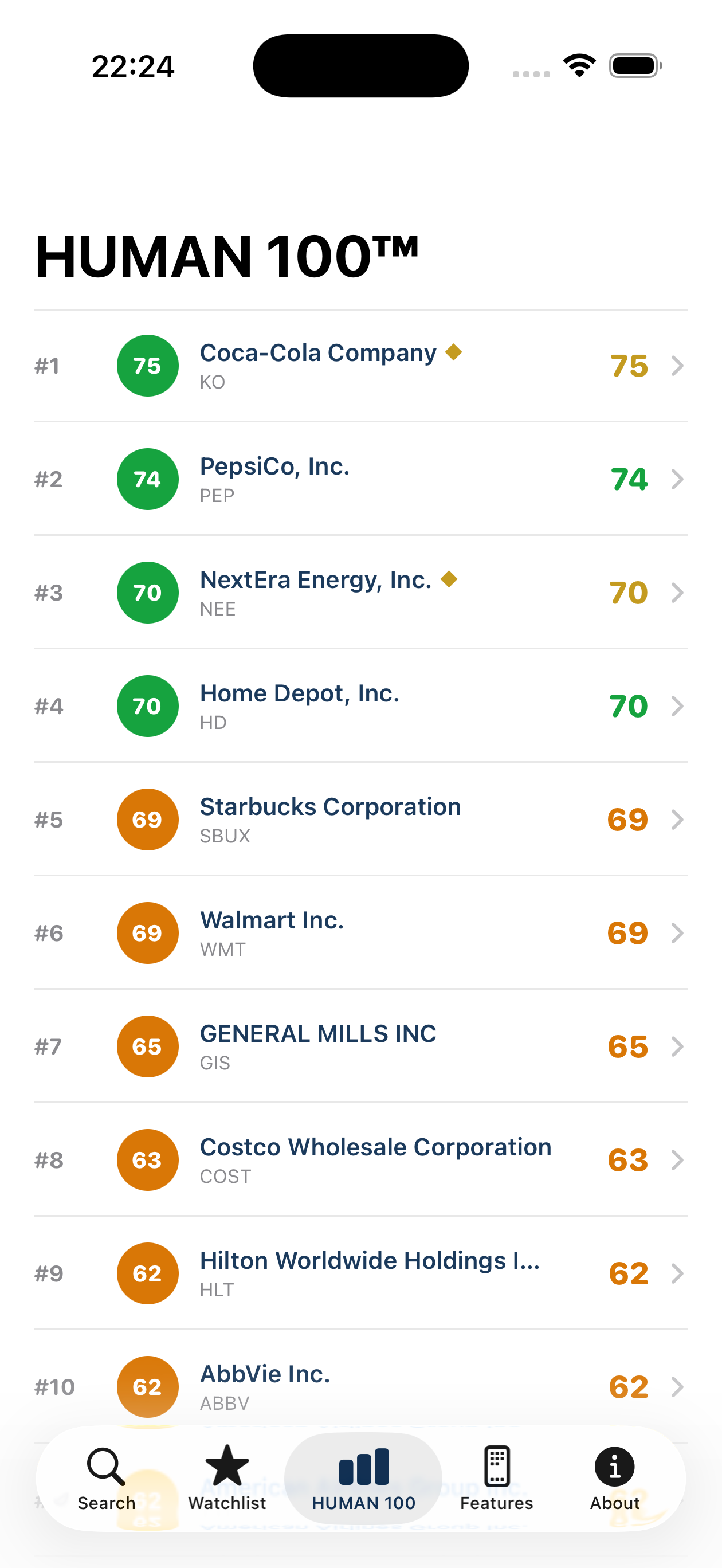
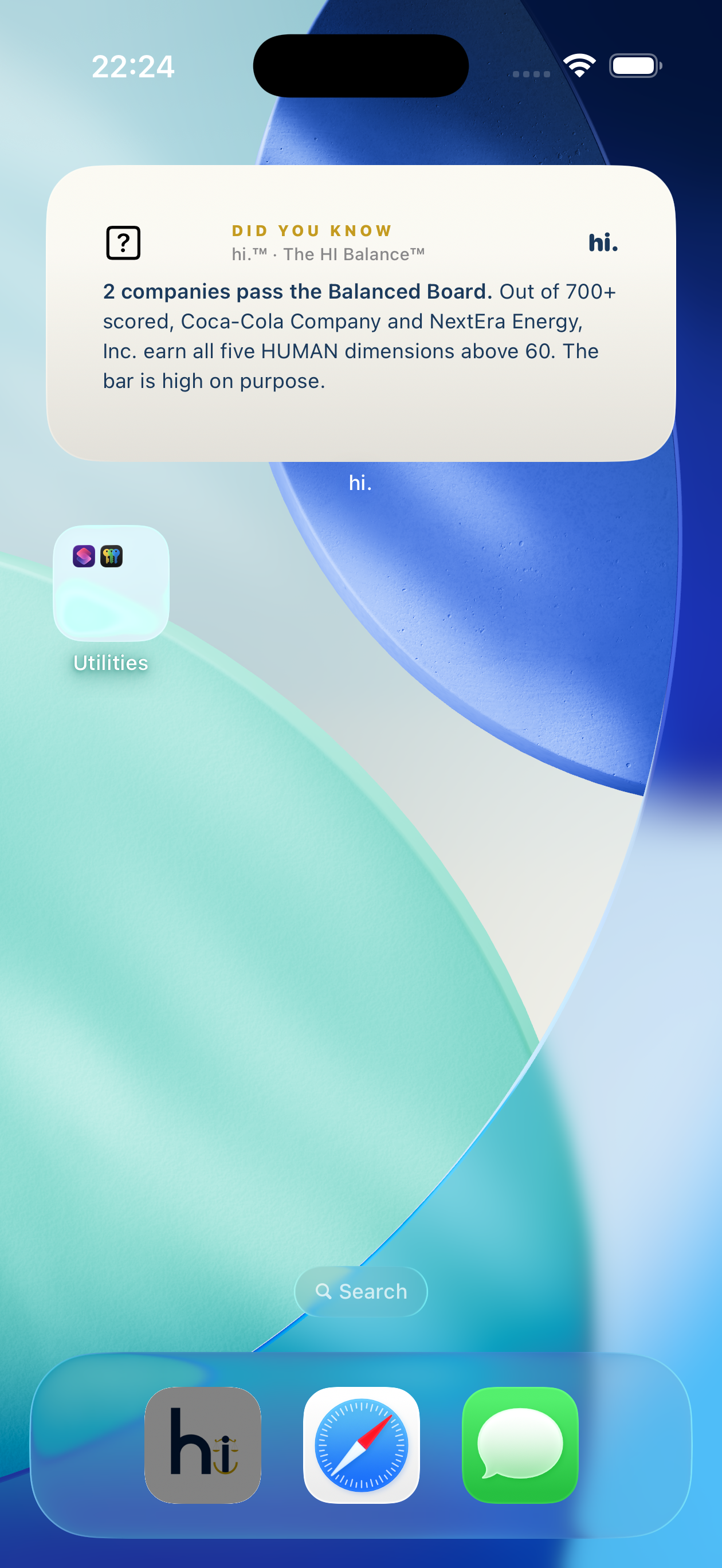
Every company is scored from 0 to 100. The score is the average of five HUMAN dimensions, each scored 0–100. Higher means more human. The Balanced Board highlights companies where all five dimensions score ≥ 60.
The HUMAN framework
HI Grade scores companies across five dimensions. Together they spell HUMAN:
H
Human Consciousness
Does the company value and invest in its people as people?
Workforce investment, craft depth, human decision depth, and AI-augmentation balance. High scorers invest in skill development and keep humans in leadership. Low scorers show revenue-per-employee anomalies (humanwashing flag) or mass layoffs without transition.
U
Understanding & Empathy
Does the company actually care about the people it serves?
Customer empathy (CFPB complaints, support quality), worker empathy (employee sentiment, safety), relational integrity (HRC, Disability:IN), simulated empathy detection. High scorers: low complaint volume, HRC recognition, accessibility commitments. Low scorers: high CFPB complaint volume, performative inclusion without follow-through, simulated empathy flags.
M
Morals & Ethics
Does the company do right by markets, customers, data, and democracy?
Pricing, data, market, product, and political ethics. Integrates Harm Documentation: settlements, deaths attributed, and concealment findings reduce M directly. High scorers: clean records, no major settlements, transparent political activity, B Corp/Fair Trade certifications. Low scorers: major settlements, harm documentation penalties, concealment findings, opaque political activity.
A
Alive & Environmental
Does the company treat the living planet as a stakeholder?
Energy and emissions (CDP Climate, Climate Neutral, SBTi), water (CDP Water), land & habitat (USDA Organic, CDP Forests), product lifecycle (iFixit, B Corp Environment, Fair Trade traceability). High scorers: CDP A/A- climate grades, SBTi-validated targets, fair trade certifications, repairable products. Low scorers: EPA violations, thin climate disclosures, high emissions intensity, hostile to right-to-repair.
N
Natural Transparency
Can you actually see what the company is doing?
Reporting quality (GRI compliance, SEC filing transparency, restatement history) and filing volume. High scorers file everything required plus voluntary disclosures. Low scorers file the bare minimum, carry restatement history, and trip humanwashing flags.
The Rubric
Every score on thehibalance.org traces back to these formulas. 19 active sub-signals. 5 deferred for v1.2. Open the table for any dimension to see the math.
H — Human Consciousness 4 active · 1 deferred
| ID | Name | Signal | Source | Status |
|---|
| H.1 | Workforce Valuation | Layoffs, WARN filings, revenue-per-employee ratio | WARN, SEC 10-K, BLS | PARTIAL |
| H.2 | Craft | Apprenticeship, training investment, craftsmanship signals | Glassdoor, Jobs, BLS | UNGROUNDED |
| H.3 | Human Decision Depth | AI-disclosed roles vs human roles, decision authority | SEC 10-K, Job Boards | UNGROUNDED |
| H.4 | Leadership Continuity | CEO turnover, board stability | — | DEFERRED |
| H.5 | Human Augmentation Index | AI as tool vs AI as replacement — measured by role composition | SEC filings, job boards | UNGROUNDED |
U — Understanding & Empathy 4 active · 1 deferred
| ID | Name | Signal | Source | Status |
|---|
| U.1 | Relational Integrity | Customer complaint volume, complaint response rate | CFPB, FTC Sentinel | PARTIAL |
| U.2 | Simulated Empathy Detection | Chatbot vs human support mix, escalation paths | Glassdoor, complaints | UNGROUNDED |
| U.3 | Culture Authenticity | Glassdoor trajectory, CEO approval vs recommend gap | Glassdoor | PARTIAL |
| U.4 | Inclusion Signal | HRC CEI score, DEI programs, accessibility | HRC, DEI disclosures | PARTIAL |
| U.5 | Community Investment Depth | Philanthropy vs PR measure | — | DEFERRED |
M — Moral & Ethical Conduct 5 active · 0 deferred
| ID | Name | Signal | Source | Status |
|---|
| M.1 | Principled Action | Regulatory violations, SEC enforcement | SEC, OSHA, EPA ECHO | PARTIAL |
| M.2 | Accountability Structure | Board independence, executive pay ratio | SEC DEF 14A | UNGROUNDED |
| M.3 | Workplace Safety | OSHA incident rate, fatality rate vs industry | OSHA via DOL | PARTIAL |
| M.4 | Optimization Harm | Algorithmic harm, dark pattern detection, AHI™ flags | Public reporting, FTC | UNGROUNDED |
| M.5 | CEO Accountability | Compensation-to-median-worker ratio, public commitments | SEC DEF 14A | UNGROUNDED |
A — Alive & Environmental 4 active · 0 deferred
| ID | Name | Signal | Source | Status |
|---|
| A.1 | Climate Integrity | CDP score, Scope 1+2+3 disclosures, trajectory | CDP, SEC Climate | PARTIAL |
| A.2 | Pollution & Compliance | EPA ECHO violations, remediation history | EPA ECHO | PARTIAL |
| A.3 | Land & Water | Industry baseline, USDA Organic, water stress | Industry, EPA, USDA | UNGROUNDED |
| A.4 | AI Infrastructure Cost | Data center power, water for compute, AI emissions | SEC, public disclosures | UNGROUNDED |
N — Natural Transparency 2 active · 3 deferred
| ID | Name | Signal | Source | Status |
|---|
| N.1 | Disclosure Quality | Readability vs legalese in material filings | — | DEFERRED |
| N.2 | Humanwashing Detection | Revenue-per-employee anomalies, AI-replaces mismatches | SEC 10-K, jobs data | UNGROUNDED |
| N.3 | Proactive Disclosure | Voluntary reporting beyond legal minimum | — | DEFERRED |
| N.4 | Material Event Timing | Time-to-disclosure for material events | — | DEFERRED |
| N.5 | Filing Volume | 8-K frequency, 10-K completeness, amendment rate | SEC EDGAR | GROUNDED |
Status Legend
GROUNDED — Every value traces to a verifiable public record. No estimates.
PARTIAL — Some values grounded in real data; coverage gaps filled with industry baselines.
UNGROUNDED — Signal exists but uses proxies or industry defaults. Ladder-to-ground roadmap documented.
DEFERRED — Sub-signal defined in spec but not yet active. v1.3 roadmap.
The three harm detection systems
HI Grade applies three harm-detection systems, all flowing into dimension scores (no separate gates):
Humanwashing™ (HW)
Selling human craft while operating algorithmically. Detected via revenue-per-employee anomalies (4×+ industry median) and AI-replaces-disclosure mismatches. Penalizes H.1.
Algorithmic Harm Index™ (AHI)
Measures algorithmic decision-making at scale. A bank's credit algorithm affects one person at a time. A social media moderation algorithm affects billions. AHI adjusts for blast radius. Penalizes M.3, U.4.
ARCHITECTURE NOTE
What happened to the Product Harm Index (PHI)?
In v1.2 we folded product safety signals directly into M.4 (Product Ethics) as sub-signal inputs — CPSC recalls, FDA warning letters, NHTSA investigations, HIBP breaches, EPA violations — rather than maintaining them as a separate index. Signals are unchanged; architecture is simpler and more traceable.
Harm Documentation (HD)
Public-record harm: court settlements, attributed deaths, concealment findings. Anchored to DOJ/SEC/state AG records, CDC/NIH attribution data, court findings. Penalizes M.3 + M.4 directly.
"Humans can still choose"
HD does not penalize companies for selling products that consumers knowingly choose: sugary beverages, alcohol, gambling, unflavored tobacco. These products may cause harm, but the harm flows from informed consumer choice. HI Grade is not the consumer's parent.
HD does penalize when consent was not possible:
- Hidden risk — the company knew about a risk and concealed it (J&J talc, tobacco MSA, Pfizer Bextra)
- Doctor-mediated harm — pharmaceutical companies that misrepresented drug safety to prescribers
- Weapons — products designed to harm humans who did not consent to being targeted
- Environmental contamination — chemical or physical harm to populations who never bought the product (PFAS in drinking water, asbestos in air)
Composite Floor Rule — v1.2.1
The composite score is the simple mean of the five HUMAN dimensions, with one floor rule:
If any HUMAN dimension scores below 42, the composite is capped at 50.
This protects against severe single-dimension failure being averaged away by strong scores in other dimensions. A company cannot earn a composite above 50 if even one HUMAN dimension is in critical failure (< 42), regardless of how the other four perform.
When the floor fires:
composite is capped at 50 (or kept at the natural mean if already ≤ 50)floor_triggered: true in the API responsetriggering_dimension indicates which dimension caused the cap (H/U/M/A/N)
This rule replaces a multi-tier floor system used in earlier specs (any dim < 10 → cap 40, one dim < 42 → cap 49, two+ dims < 42 → cap 41), simplified to one clear, defensible threshold.
Examples:
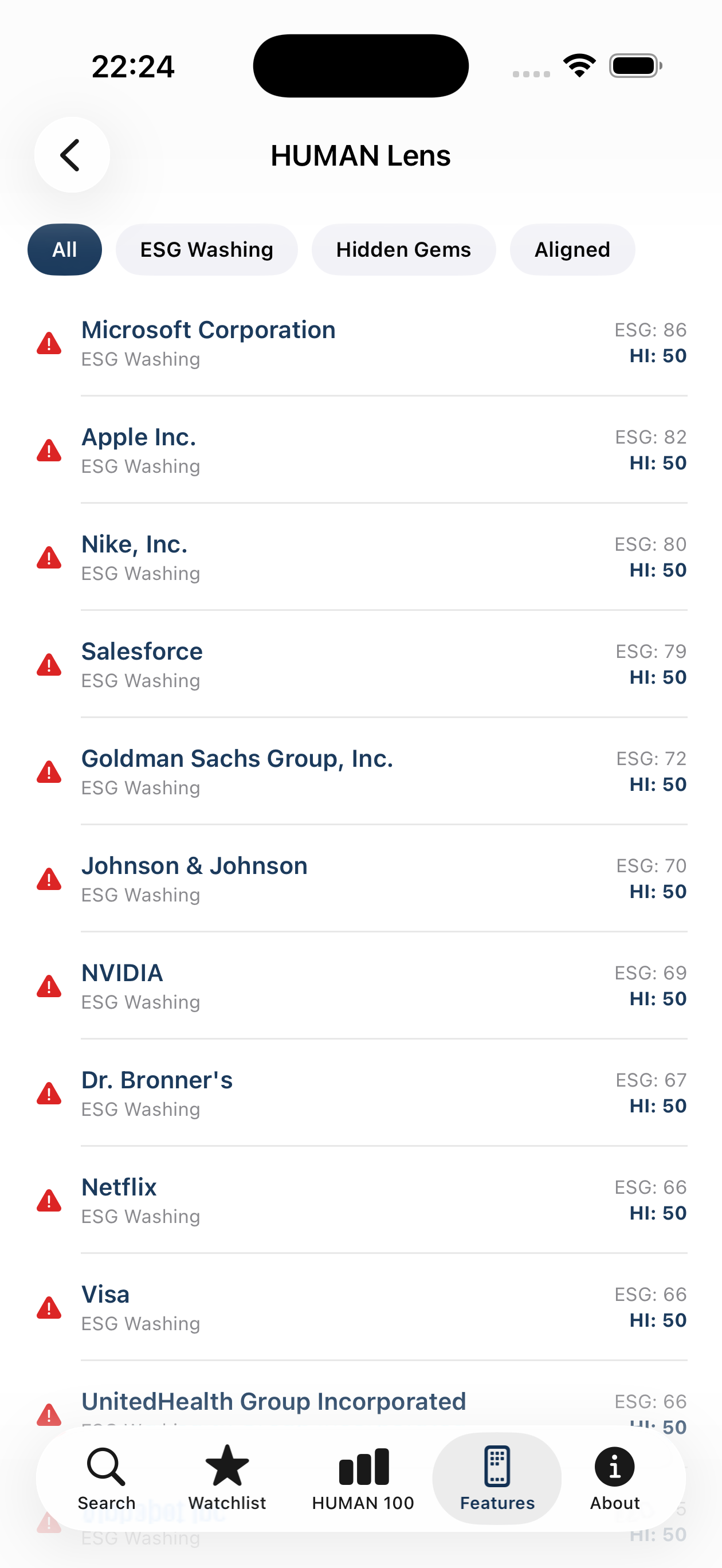
- Johnson & Johnson: D_M = 0 (Harm Documentation penalty) → composite capped at 50
- Costco: D_N = 27 (CDP grade D + thin SEC filings) → composite capped at 50
- Microsoft: D_H = 35 (mass layoffs, AI-acceleration penalty) → composite capped at 50
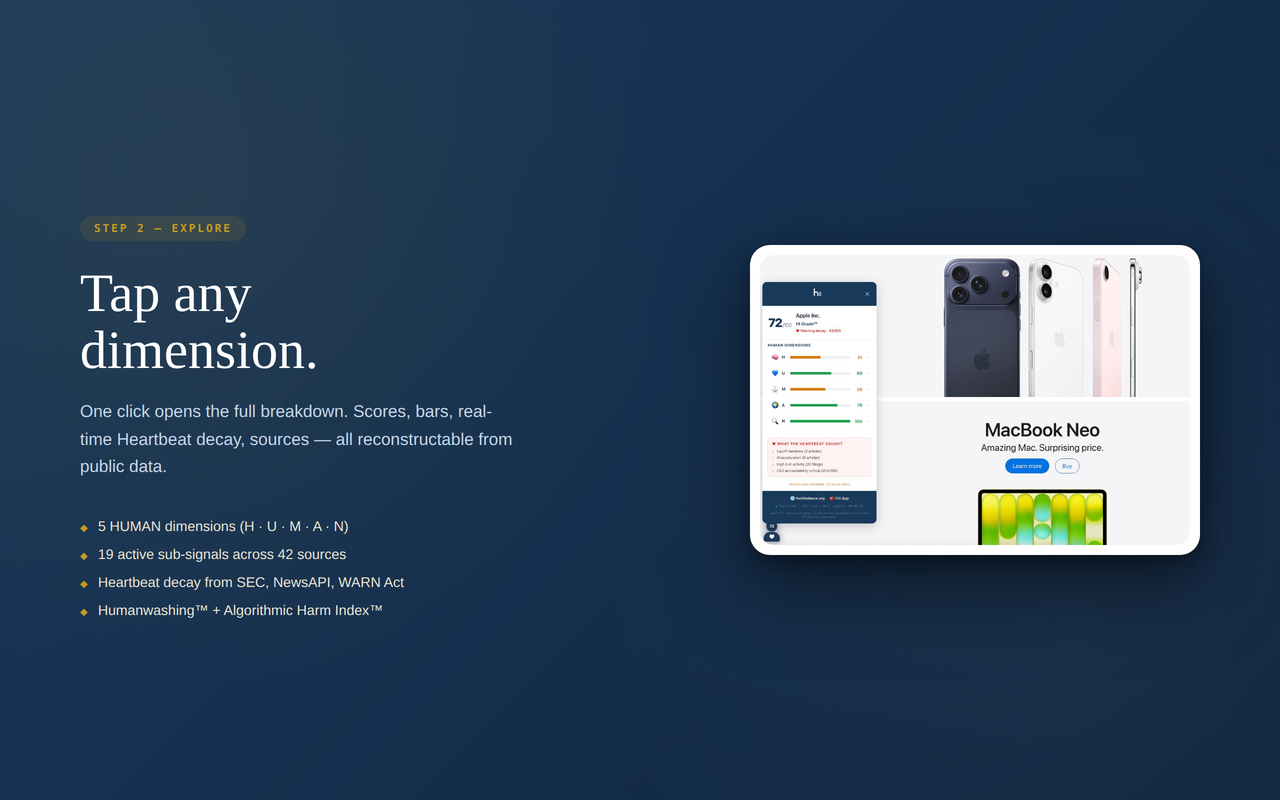
- Apple: minimum dimension D_H = 50 → no cap, composite = mean (73)
Note: sub-signal scores below 42 do not trigger the floor. Only dimension-level scores (D_H, D_U, D_M, D_A, D_N) count. Sub-signals are component inputs; the dimension is what matters for floor evaluation.
Balanced Board — v1.2.1 criteria
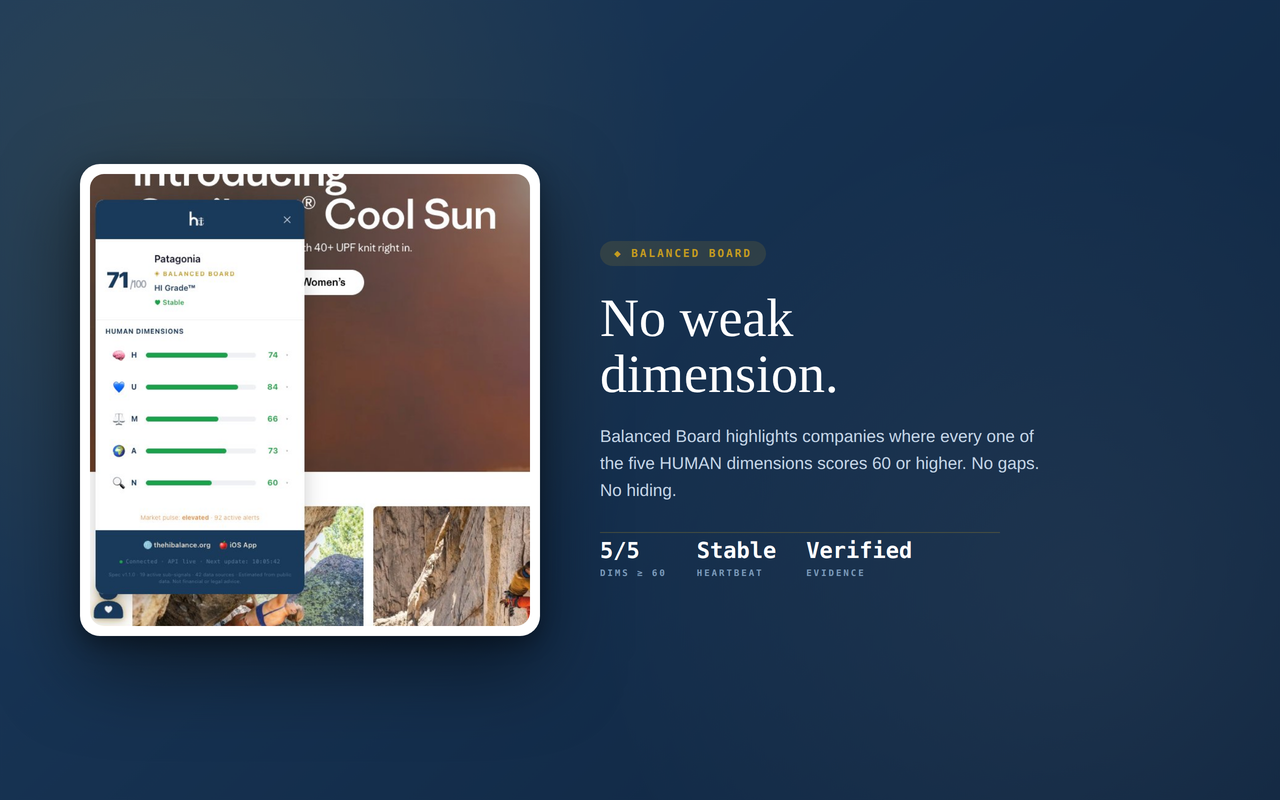
The Balanced Board highlights companies with no weak HUMAN dimension. Earned algorithmically, never purchased. A company makes the Balanced Board when it meets all three criteria:
1
Dimensions
All 5 HUMAN dimensions score 60 or higher. No single weak dimension allowed.
2
Evidence
Each dimension has at least one real public source. Industry defaults don't count.
3
Momentum
Not in warning or critical decay based on 90-day trailing signals.
Why three gates instead of one composite
A single weighted composite — the approach most ESG frameworks use — averages away disqualifying signals. A company can be excellent on four dimensions and ethically compromised on the fifth, and still rate highly. HI Grade refuses to do this. Each dimension is an independent check.
Why momentum — the Oracle problem
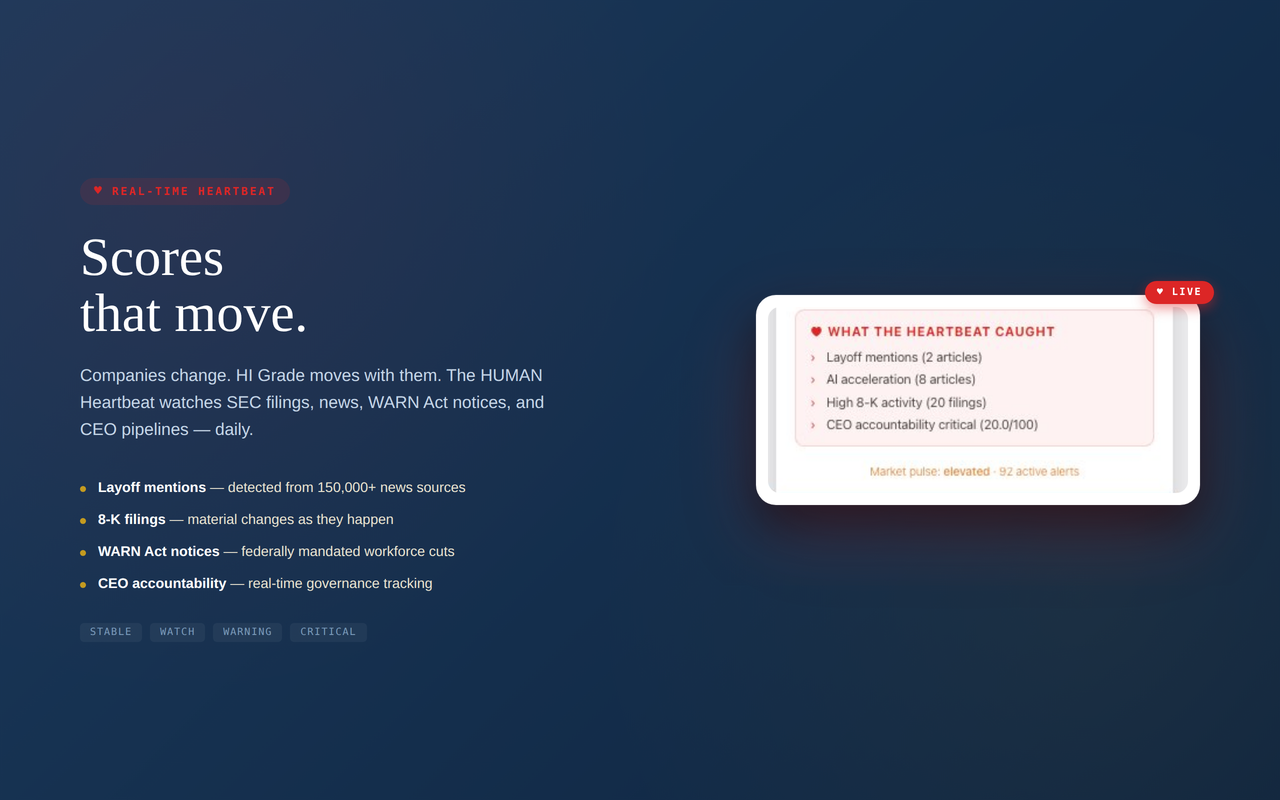
When Oracle executed mass layoffs in April 2026 affecting an estimated 25,000+ workers, their backward-looking SEC filings still showed the pre-layoff workforce. A scoring system reading only last-quarter's 10-K would have given Oracle a high H score the day thousands of workers were locked out of internal systems at 6 a.m. EST. HI Grade's momentum gate catches this in real time by monitoring news, 8-K filings, WARN Act notices, and other decay signals across a 90-day rolling window.
Score Integrity Rules
Every score passes through three validation layers. They exist to prevent any single source — including bad data, gaming attempts, or short-term news cycles — from distorting the math.
LAYER 1
Input validation
Before any data enters scoring, it's checked for sanity. Negative headcounts, impossible Glassdoor ratings (above 5.0 or below 1.0), revenue-per-employee anomalies, and other physically impossible inputs are rejected at ingestion. The pipeline logs the rejection and continues with verified inputs.
LAYER 2
Output validation
After scoring, results are checked for stability and shape. Sub-signal scores must fall within their defined ranges. Composite scores are checked against historical stability — large unexplained moves trigger manual review. Distribution shape is monitored — if every company suddenly scored 70+, something broke. Known leaders (companies on the Balanced Board for 6+ months) act as sentinels: sudden drops trigger investigation.
LAYER 3 · MSSI
Maximum Single-Source Impact
No single source can move a sub-signal score by more than 15 points. If one CFPB report would change U.1 by 30 points, the impact is capped at 15. The remaining movement requires a corroborating source.
This prevents a single bad data point — or a coordinated gaming attempt — from poisoning a score. The cap exists because we trust no source completely, including ourselves.
Verify any score yourself
Every HI Grade is reconstructable from public data. The API returns every sub-signal value, every source, every penalty applied. No black boxes.
TRY IT
curl https://api.thehibalance.org/api/v1/score/ticker/JNJ
The response contains the full breakdown:
- 19 sub-signal scores with linked sources
- 5 dimension aggregates with the math
- AHI components (if applicable) —
division / addiction / manipulation / transparency / human_override
- HD rubric (if applicable) — settlements USD, deaths attributed, concealment findings, source URLs
- Composite score with the formula used
- Confidence level, coverage, and spec version
The entire pipeline source is on GitHub under Apache 2.0. Run it yourself. Get the same answer. That's the point.
How to dispute a score
HI Grade is estimated from public data. Sometimes public data is wrong, or missing, or misattributed. When that happens, the score is wrong. We fix it.
- Verify via API. Pull the current response (above) and identify which sub-signal you're disputing.
- Find the public-record source supporting your correction. We require a citable source — press releases and internal data don't qualify.
- Email hi@thehibalance.org with subject
[SCORE-CHALLENGE] TICKER and include: sub-signal, current value, proposed value, citation URL.
- We verify against the public record. If the data is wrong, we fix it within 5 business days. Fix deploys with the next pipeline run.
What we don't do: remove unflattering scores on request. A score based on verified public data stays. If you disagree with the methodology, the source is open — propose a better rubric.
Report a security issue
Found a security vulnerability? Don't open a public GitHub issue. Email hi@thehibalance.org with subject [SECURITY] and a description of the issue.
Full scope, acknowledgement timelines, and what we care about: SECURITY.md on GitHub.
Known Limitations
A transparency framework that hides its own limitations is hypocritical. Every limitation below is tracked and has a path forward. The math decides — and when the math is incomplete, we say so.
Editorial tier cutoffs on authoritative data
This is the dominant pattern in v1.2.0. Most scoring uses authoritative data (SEC, CFPB, OSHA, EPA, CDP) with editorial thresholds. The data is ground truth; the score bands (e.g., <100 CFPB complaints per $B = 85 points) were chosen by engine authors.
Path forward: grounding thresholds against B Corp quintiles, CFPB published distributions, BLS industry medians.
5 sub-signals spec'd but not yet scored
Five sub-signals (H.4 Decision Authority, U.5 Moral Courage, N.1 Reporting Quality, N.3 Subsidiary Transparency, N.4 Supply Chain) are spec'd but deferred to v1.3 because the data ladders aren't ready.
Path forward: v1.3 target. Each requires either a new data source or a new scoring ladder.
CFPB covers financial services, not everyone
CFPB complaints power U.1 (Customer Empathy) and M.1 (Pricing Ethics). Banks, credit cards, mortgages, debt collectors are covered well. A coffee company isn't. For ~80% of companies we score, CFPB returns zero — not because they're saints, but because CFPB doesn't regulate that sector.
Path forward: BBB complaints (now ingested), FTC actions (already scoring), CPSC SaferProducts (already scoring). Per-sector regulators being audited.
iFixit repairability covers ~15 companies
iFixit publishes detailed repairability scores for consumer electronics — Apple, Samsung, Dell, HP, Microsoft Surface, ~10 others. For the other 700+ companies, A.4 (Product Lifecycle) falls back to industry defaults.
Path forward: EU Extended Producer Responsibility datasets publish repairability scores. Ingestion planned for v1.2.
Harm Documentation strong post-2020, limited before
Harm Documentation covers 14 categories with strong coverage from 2020 onward. For historical events — tobacco, asbestos, J&J talc — we maintain a curated Major Harm Events dictionary encoding court settlements. Confident in the dictionary, but incomplete.
Path forward: systematic backfill from EPA Superfund site attributions, state AG settlement databases, academic attribution studies.
Industry Revenue-Per-Employee medians are hardcoded
Many sub-signals normalize by industry. Medians were derived from aggregated SEC data but are currently hardcoded constants. Last refresh Q1 2026; next scheduled Q3 2026.
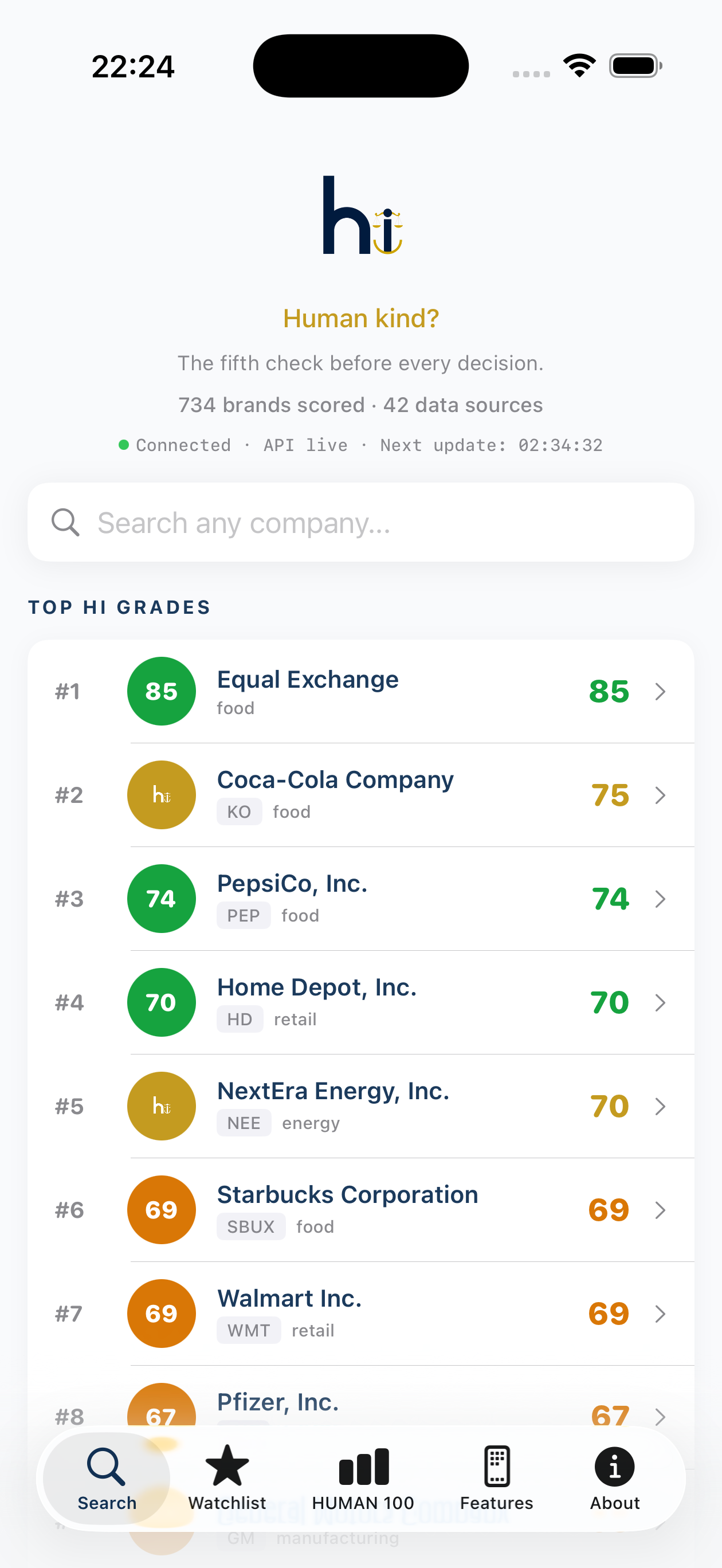
When per-company SEC workforce data is unavailable, sub-signals fall back to these industry medians. This affects roughly 30-40% of the S&P 500 universe today and means companies in the same industry can show identical H sub-signals — e.g., Coca-Cola and Starbucks both default to consumer-goods medians until broader workforce data sources are integrated. We disclose rather than mask the fallback; expanding per-company H signal coverage is on the v1.2.1 roadmap.
Path forward: dynamic industry median computation from the live company universe. Technical work planned for v1.3.
v1.0.2 renormalization note: H.4 (CEO Accountability) was removed from the H-dimension calculation. CEO accountability is now reflected in the Heartbeat decay system and in M.4 (Product Ethics). Remaining H sub-signals (H.1, H.2, H.3, H.5) were proportionally rescaled to sum to 1.0.
D_N weights note: D_N (Natural Transparency) currently uses equal 0.5/0.5 weights between N.2 (Reporting Quality) and N.5 (Filing Volume). Sub-signals N.1, N.3, N.4 are deferred to v1.3. Additional grounded signals (DSA transparency, 12b-25 late-filings) are on the v1.3 roadmap.
Heartbeat decay thresholds are editorial
The Decay Index aggregates layoff mentions, 8-K filings, WARN notices, CEO accountability into 0-100. Inputs are authoritative; thresholds mapping to Stable / Watch / Warning / Critical are editorial.
Path forward: validating against known decay events (Oracle 2026, Twitter 2022, Meta metaverse pivot). Ongoing.
Measured without AI
HI Grade uses no AI in the scoring pipeline. No large language models summarizing reports. No neural networks classifying sentiment. No machine learning inferring "good" or "bad." Every score is a deterministic computation on public data.
We do use AI to help build the system — write Python, draft documentation, test edge cases. We don't use AI to judge any company. The distinction matters: LLMs are excellent for engineering work and explanation, and untrustworthy for the kind of consistent, auditable, high-stakes judgments ESG ratings require.
The entire value proposition of HI Grade is reproducibility and trust. An LLM-generated score can't be reproduced exactly, can't be audited line-by-line, and can't defend itself against "why did you rate us that way?" in a regulatory or legal context. Math and data can.